Pier Holes
Getting bored piers filled cleanly and to the correct level, with no concrete spilled down the sides and no voids left behind. Accuracy at this stage saves hours of cleaning up and rework afterwards.
Newcastle Concrete Services
Line and boom pumping that gets concrete exactly where it needs to go, including the parts of a site a truck will never reach.
Project Overview
Line and boom pumping that gets concrete exactly where it needs to go, including the parts of a site a truck will never reach.
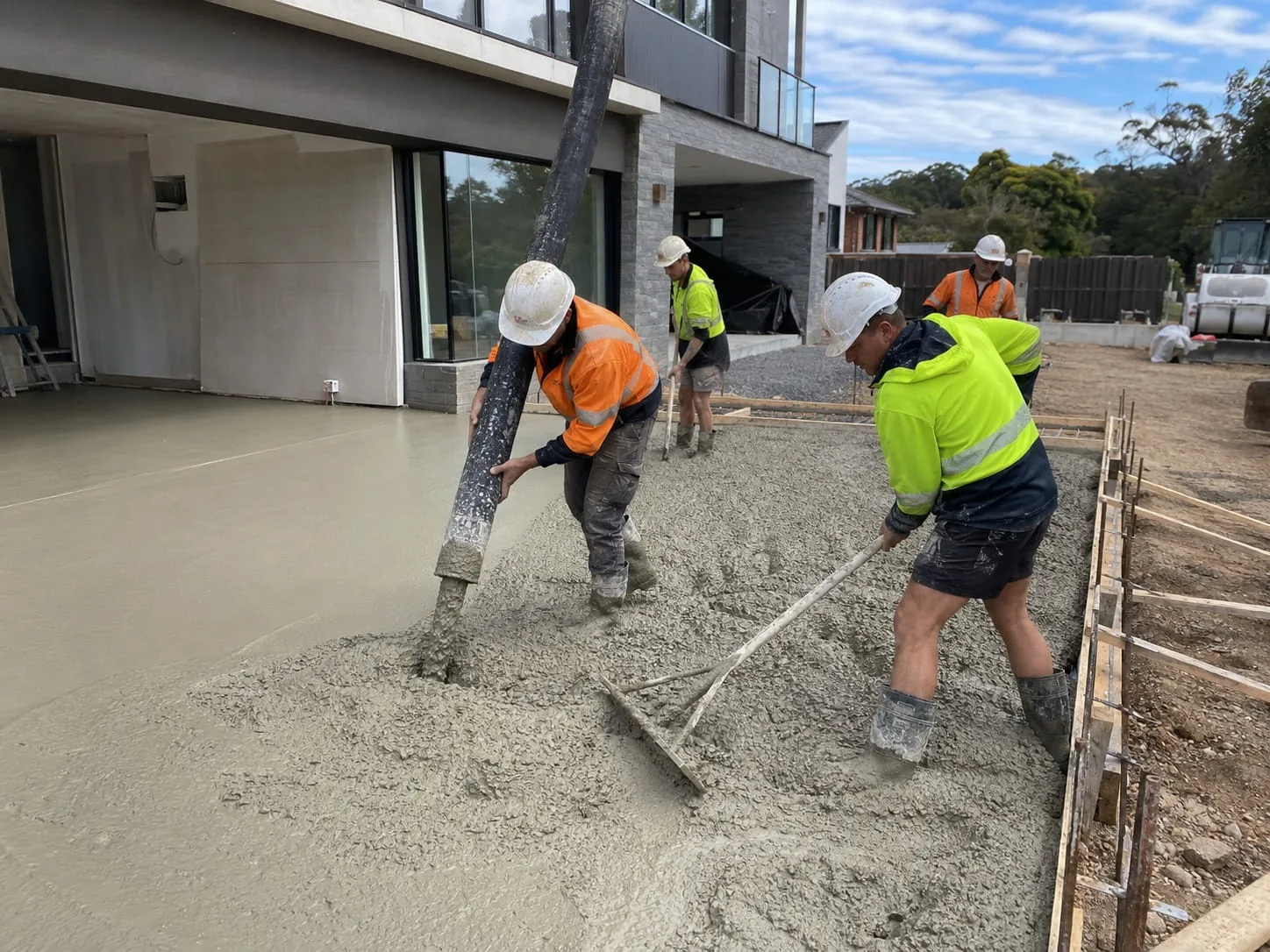
Plenty of pours cannot be reached by a truck and a chute, and barrowing thirty cubic metres down a side path is nobody's idea of a plan. Our concrete pumping Newcastle team provides line and boom pumping for jobs of every size, from tight residential access through to larger commercial pours.
We assess access and volume before the day so the right equipment turns up, the line run is as short as it can be, and the pour keeps moving. Pumping places concrete quickly and evenly, which reduces labour time and, more importantly, avoids the cold joints and inconsistent finish that come from a pour that keeps stopping.
Backyard slab behind a Federation cottage or a commercial pour on a programme, pumping is what makes the difference between a straightforward day and a very long one.
Where We Pump
Pumping earns its keep whenever wheelbarrows would slow a pour down or the truck simply cannot get close enough. That covers a great many Newcastle blocks: a narrow side path between two workers cottages in Islington or Tighes Hill, a rear lane too tight for a truck, a steep drop to the backyard on a Charlestown or Merewether Heights block, or a pour that has to go over a fence. These are the jobs we are called out for most.
Getting bored piers filled cleanly and to the correct level, with no concrete spilled down the sides and no voids left behind. Accuracy at this stage saves hours of cleaning up and rework afterwards.
Bigger volumes, tighter programmes and other trades to work around. We pour to your schedule and keep the line charged, so your finishing crew is never standing about waiting on the next load.
The bread and butter: backyard slabs, patios, pool surrounds and anything behind a house with no truck access. A line run down the side of the property solves most of it.
Driveways, crossovers and garage aprons where a truck cannot reverse in, or where the pour has to be placed in one continuous run to avoid cold joints in the finished surface.
Strip and pad footings placed straight into the trench, so the sides stay intact and loose spoil is not knocked back down onto concrete that has only just been placed.
Core-filling block walls and retaining structures, where the concrete has to travel into narrow cores in controlled lifts instead of being tipped in and left to find its own way down.
House slabs, shed slabs and general hardstand. Pumping gets a large pour placed quickly and evenly, which matters when the slab has to be finished as one continuous piece.
Larger Pours
Bigger pours change the equation. Once you are moving serious volume the limiting factor stops being the mix and becomes how consistently you can place it, because a slab that goes off unevenly creates a finishing problem you cannot undo. For that work we plan the pour sequence with you beforehand, agree where each section starts and stops, and keep the line charged so there is no stop-start through the placement.
Access on larger and rougher sites is the other constraint, and it is where a four-wheel-drive truck-mounted pump earns its place. Being able to drive onto an unformed site, a rain-soaked block or a steep cut means the pump reaches a position where the line run is short and manageable, rather than setting up on the street and pushing concrete a long way. After a wet week — and the Hunter delivers plenty of those — that is frequently the difference between a routine pour and a bogged truck.
Longer line runs, multiple pours across a programme and pours with restricted overhead clearance all need working out in advance rather than on the morning. Tell us the volume, the site conditions and your programme dates, and we will tell you what setup suits and what we need from you on the day to keep it moving.
Send us the suburb, rough dimensions, what is there now and the finish you have in mind, and we will come back with a proper price.